Best Start in Life - Screen Time
Digital screens are now a normal part of family life. The early years are however critical for development - 90% of a child’s brain development occurs by age 5, making it a critical period for the development of social, emotional and cognitive skills. Consequently, on Friday 27 March, the government published new, evidence-informed guidance to help parents and carers of children under 5 navigate screen time.
Campaign details
Target audience: Parents and children, Healthcare professionals
Topics: Childhood health, Early years
Campaign start date: 27th March 2026
Campaign end date: Always on
Overview
On Friday 27 March, the government published new, evidence-informed guidance to help parents and carers of children under 5 navigate screen time.
Digital screens are now a normal part of family life. The early years are however critical for development - 90% of a child’s brain development occurs by age 5, making it a critical period for the development of social, emotional and cognitive skills.
The advice is informed by recommendations from an expert panel and has also been developed with parents. It is designed to provide practical, clear and straightforward advice to help families make informed choices that support their child’s development during the years that matter most.
The advice is available on the Best Start in Life website. The full expert panel independent report, which this advice is informed by is available on GOV.UK.
Context
Screens are part of most children’s daily lives, with nearly, 98% of two-year-olds watching television, videos or other digital content on a screen on a typical day. The early years are however a critical period of rapid brain development and there is some evidence that screen use may have a negative impact on a child’s health and cognitive and socio-emotional development.
The Government commissioned a review because it recognises the need to balance the embracing of technology with promoting the health and development of younger children.
In January 2026, the Early Years Screen Time Advisory Group (EYSTAG) was established by the Department for Education (DfE) and the Department of Health and Social Care (DHSC) to review the currently available evidence on early years screen time and to inform new Government guidance on screen time for children aged under five.
Professor Russell Viner, a paediatrician and expert in children’s health, and Dame Rachel de Souza, the Children’s Commissioner for England, co-chaired a group of experts, supported by a secretariat from DfE and DHSC.
Resources

Campaign Communications Toolkit
A guide to the Best Start in Life - Screen Time campaign, with an outline of the campaign context and key messages.
Last updated: 27 March 2026
Social Assets
Ready to use social assets for paid and organic social media activity.
Last updated: 27 March 2026
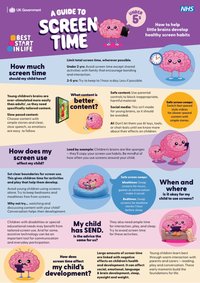
A4 Infographic
Ready to use A4 Infographics for use as posters or on websites.
Last updated: 27 March 2026

Digital Screens
Static campaign awareness screens for use on digital displays and TVs.
Last updated: 27 March 2026
Published: 27 March 2026